
Memory book questions that get specific answers
Choose a question about one place, object or day, then ask a short follow-up if the contributor wants to say more. Let them skip questions and check the account before sharing it.
Choose a subject the contributor knows and is happy to discuss. An object or photograph can provide a starting point, but nobody has to recall or explain a particular part of their life.
Use the questions below with a relative in person, or send a few to each contributor to a group book. Reword any of them to suit the person.
Put these words on a page
Add your photos and write beside them in a digital scrapbook.
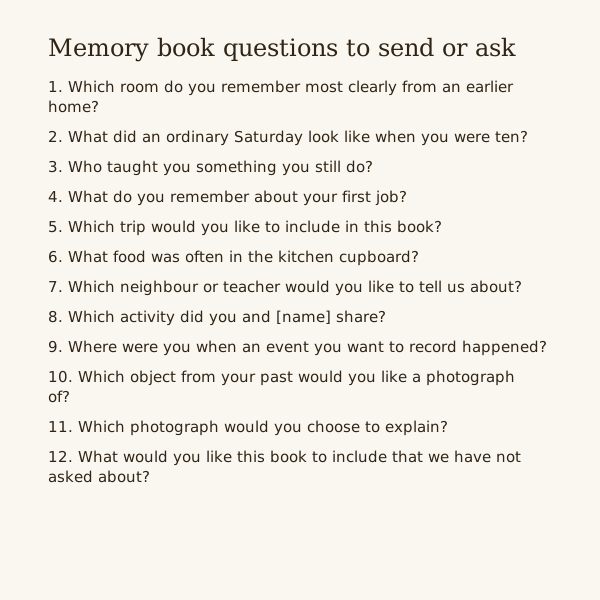
Memory book questions to send or ask
- Which room do you remember most clearly from an earlier home?
- What did an ordinary Saturday look like when you were ten?
- Who taught you something you still do?
- What do you remember about your first job?
- Which trip would you like to include in this book?
- What food was often in the kitchen cupboard?
- Which neighbour or teacher would you like to tell us about?
- Which activity did you and [name] share?
- Where were you when an event you want to record happened?
- Which object from your past would you like a photograph of?
- Which photograph would you choose to explain?
- What would you like this book to include that we have not asked about?
How to phrase a question
Name a time, place or object, and leave the answer open. A question about one room is easier to locate on a page than a request for a whole childhood.
Ask one thing per question. When two are joined with and, the second one is usually the only one answered.
Let the person decide whether to describe events, feelings or both. Avoid steering them towards an answer you expect.
- Start with who, what, where or which.
- Point at a photo and ask who took it.
- Follow any answer with: who else was there?
- Ask for a number: how many, how far, how much.
Questions grouped by subject
Give each sitting or each contributor one subject. A list mixing home, work and love gets thin answers to all three.
- Home: which room did everyone end up in, and why that one?
- School: who sat next to you, and where did they end up?
- Work: who showed you how the job was really done?
- Family: who could fix anything, and what did they fix for you?
- Food: what was cooked when there was something to celebrate?
- Places: where did you go when you wanted to be on your own?
Sending questions to contributors
Send three questions, not thirty. A long list looks like homework and comes back half done or late.
Give a date to reply by and say who will see the book. People write differently for a family book than for one passed round at a party.
Ask for a photo with each answer. Even a phone picture of an old print gives the words something to sit beside on the page.
In tbf scrapbook, contributors answer through a link with words, photos or a voice recording, and the book's owner chooses what goes in.
Asking a relative in person
Bring a photo or an object to the conversation and ask about it. Holding something gives a person a place to begin.
Record only with their agreement, and write answers close to how they were said. Check the spelling of names and places before they go on a page.
Agree how long to talk and let the person stop or change the subject. If you record, check which parts they want kept before using the material.
Steps
Match subjects to people
Decide what the book covers, then pair subjects with people: a sibling for childhood, a colleague for work, an old friend for one decade.
Write and test the questions
Read each question for assumptions and multiple parts. Start with one subject and keep any follow-up separate, so the person can choose how much to answer.
Ask or send
Send three questions to each contributor with a reply date, or take one subject and one photo to a visit.
Sort and check the answers
File answers by subject. Confirm names, dates and spellings with the person who gave them before anything is laid out.
Questions
How many questions should a memory book have?
As many as you have pages to fill. Three to five per contributor is enough; one good answer with a photo fills a page.
What if someone does not want to answer a question?
Let them skip it without asking why. Offer a different subject, or ask for a photo and a few words about it instead.
Can I send the same questions to everyone?
You can, but the answers will overlap. Different subjects for different people make the book cover more ground.