
History scrapbook project: sources, timeline and captions
Pick one person, event or short period, gather primary sources from the time, cite each as you save it, and build the pages around a timeline. The captions are in the student's own words.
Start with the assignment sheet. Highlight the required parts, such as page count, number of sources, citation style and due date, and plan the pages from that list, not from ideas online.
Unlike a report, the evidence sits on the page and the writing explains it. Parents can help find and print sources, but the choices and the captions should be the student's.
Make the memory book together
Invite people to send photos and their own words, then choose what goes in the book.
| Question | Record | Page consequence |
|---|---|---|
| Who made it? | Creator and role, or unknown | Name the perspective |
| When was it made? | Date and distance from the event | Separate later recollection from contemporary record |
| Why was it made? | Audience and purpose if known | Avoid treating an advert as a neutral description |
| What does it show? | Observation and supported inference | Do not claim more than the source supports |
| What is missing? | Gaps or another source to compare | Keep uncertainty visible in your own caption |
Narrow the subject
A person, an event or a few years gives enough to fill pages without turning into a textbook summary. The Great Fire of London works better than the whole seventeenth century.
Check that sources can be reached before committing: digitised archives, a local museum, library collections. A subject with no images available will be hard to fill.
Find primary sources
A primary source provides first-hand evidence for your question, such as a photograph, letter or later eyewitness account. Its relationship to the event matters, not just when it was made.
The US National Archives offers analysis worksheets for different media and levels, plus a perspective worksheet. Use one to question who made a source and why.
- National and local archive websites with digitised collections.
- Museum online collections.
- Newspaper archives through the school or public library.
- Letters or photos from older relatives, for a recent period, used as copies.
Cite each source when you save it
Write the citation the moment an image is saved; finding it again later is slow. Keep a numbered list: creator, title or description, date, where the original is held, web address and date viewed.
Use the citation style the teacher sets. If none is set, ask; otherwise put a short form under each source and the full list on the last page.
Timeline first, then captions
A timeline across one spread fixes the order before the detail pages are made. Mark 6 to 10 dated events and give each the number of the source page that covers it.
The National Archives method moves from meeting a document to observing its parts, making sense of it and using it as evidence. A caption of two or three sentences can follow the same order.
Do not copy the archive's own description. Say what the source is, what you notice in it, and what it shows about the time.
Keep observation separate from interpretation. A posed photograph shows what was arranged for the camera; it does not by itself prove what every day was like.
Pages to make
Title page and question
The subject and one question the project answers, such as why the fire spread so fast. Every later page should help answer it.
Timeline spread
A line across both pages with 6 to 10 dated events. Under each, a small image and the number of the source page that covers it.
Source pages
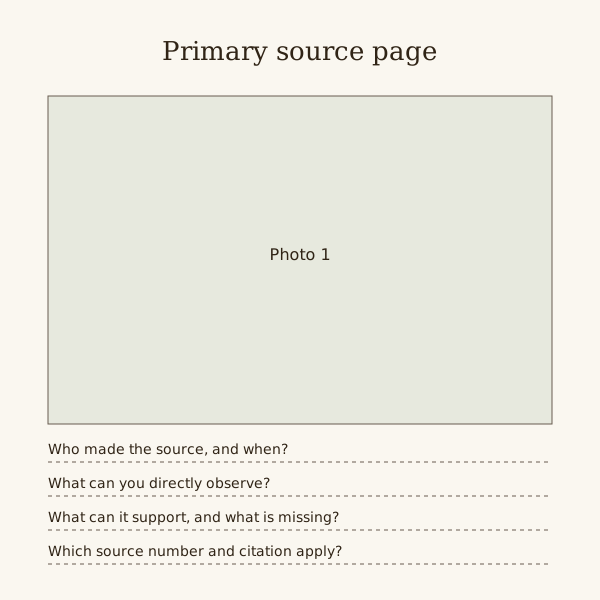
One primary source per page, printed large enough to read, with a caption in the student's words and the citation underneath.
Answer and sources list
Answer the opening question using the sources by number, then list every citation in full on the last page.
Questions
What counts as a primary source for a school project?
First-hand evidence for your question: a photograph, diary, object or eyewitness account. A later recollection may qualify, but explain when it was recorded and what its limits are.
How do I cite a photo from an archive website?
Give the photographer if known, a title or description, the date, the archive's name, the web address and when you viewed it. Follow the teacher's style if one is set.
How much should a parent help?
Finding sources, printing and checking the assignment sheet are fair help. Choosing the sources and writing the captions are the student's work.