
Pet photo book: sharp photos of a pet who will not sit still
Photograph at the pet's eye level in good light, use Burst for movement, and fill the book with ordinary days: where they sleep, their routine hour by hour, and who they live with.
Choose the period the book records: a first year, an ordinary week or the photos you have across a pet's life. A book can stop wherever the available material and your choice take it.
Most pet photos on a phone show the same face from the same height. A book needs more range: the whole body, the room around them, paws, the people they lean on.
Make your photobook
Arrange your photos on A4 pages, check the proof and order a printed copy.
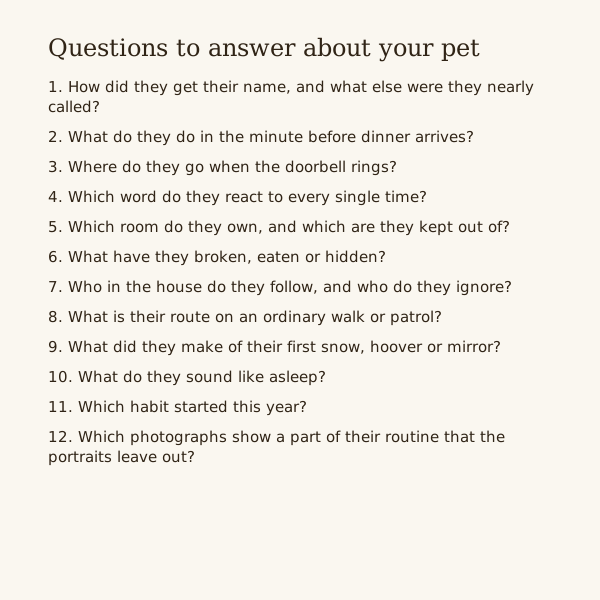
Questions to answer about your pet
- How did they get their name, and what else were they nearly called?
- What do they do in the minute before dinner arrives?
- Where do they go when the doorbell rings?
- Which word do they react to every single time?
- Which room do they own, and which are they kept out of?
- What have they broken, eaten or hidden?
- Who in the house do they follow, and who do they ignore?
- What is their route on an ordinary walk or patrol?
- What did they make of their first snow, hoover or mirror?
- What do they sound like asleep?
- Which habit started this year?
- Which photographs show a part of their routine that the portraits leave out?
Sharp photos of an animal on the move
Apple's Burst mode takes photos in rapid succession while you swipe and hold the shutter to the left, then you keep the frames you want. Use it for running, jumping and catching.
Apple's Live Photos keep 1.5 seconds either side of the moment you tap. If the eyes shut in the main frame, pick a different key photo from those seconds.
On supported iPhones, a dog or cat photo taken in ordinary Photo mode can be given portrait blur afterwards, so there is no need to switch modes mid-moment.
If a familiar person helps, ask them to stand near the lens. Use the pet's usual handling routine and let it leave; the photo does not require a held pose.
Light, fur and eyes
Indoors, work near a window in daytime. In dim light the camera uses a slower shutter, and a moving animal smears.
Focus on the eye nearest the lens. When the eyes are sharp, a blurred tail reads as movement rather than a mistake.
Black fur loses detail in shade and white fur loses it in hard sun. Shoot dark pets in bright, even light and pale ones in open shade.
Get down to their height: on the floor for a cat or rabbit, crouched for a dog. Photos from standing height all look down on the same head.
A shot list for the months ahead
Take these on purpose over a few months. They fill the gaps a camera roll of faces leaves.
Choose one wide scene, one closer view, one detail and one quiet moment from each period. Mark gaps in that set rather than filling a chapter with many frames from the same burst.
- Whole body, side on, against a plain wall
- Paws, nose and ears, close up
- Asleep, from directly above
- With each person in the house, for scale
- The bowl, lead, bed and favourite toy, on their own
- Out on the usual route, once in each season
- Mid-yawn, mid-shake or mid-stretch
Rabbits, birds, fish and horses
Rabbits and guinea pigs: sit on the floor of the run so the lens is at their height, and let them come to you.
Birds or fish behind glass: photograph from outside the enclosure and move room lights out of the reflection. Avoid flash and disturbing the animal to obtain the shot.
Horses: a stable photo shows the face and tack, and a field photo shows how they move. A book wants both, with the yard or field named.
Steps
Name and numbers
The earliest photo you have, beside their name, how they got it and the date they arrived. Add their size then and now, photographed by the same cushion.
An ordinary day, hour by hour
Six photos from one day, each captioned with the clock time: first stretch, breakfast, the window, the walk or patrol, the evening spot, bed.
Their territory
A sketched floor plan of the house or garden in the middle, with small photos round it of each spot they claim, joined to the plan by lines.
The household
One photo with each person or animal they live with. A long dog stretched out suits a landscape page; a printed tbf scrapbook book can be A4 landscape or portrait.
Questions
How do I get a sharp photo of my dog running?
Use bright daylight, get low, and hold Burst as they run towards you. Keep the frames where the eyes are sharp; a blurred tail is fine.
What should go in a pet photo book?
Their name and arrival, an ordinary day, the places they claim, the people and animals they live with, and the habits only your household knows.
How many photos does a pet photo book need?
A 20 page book at three photos a page takes about 60. Use fewer, larger photos for portraits and more, smaller ones for a routine shown in sequence.