
Sports yearbook spreads: scores, rosters, action
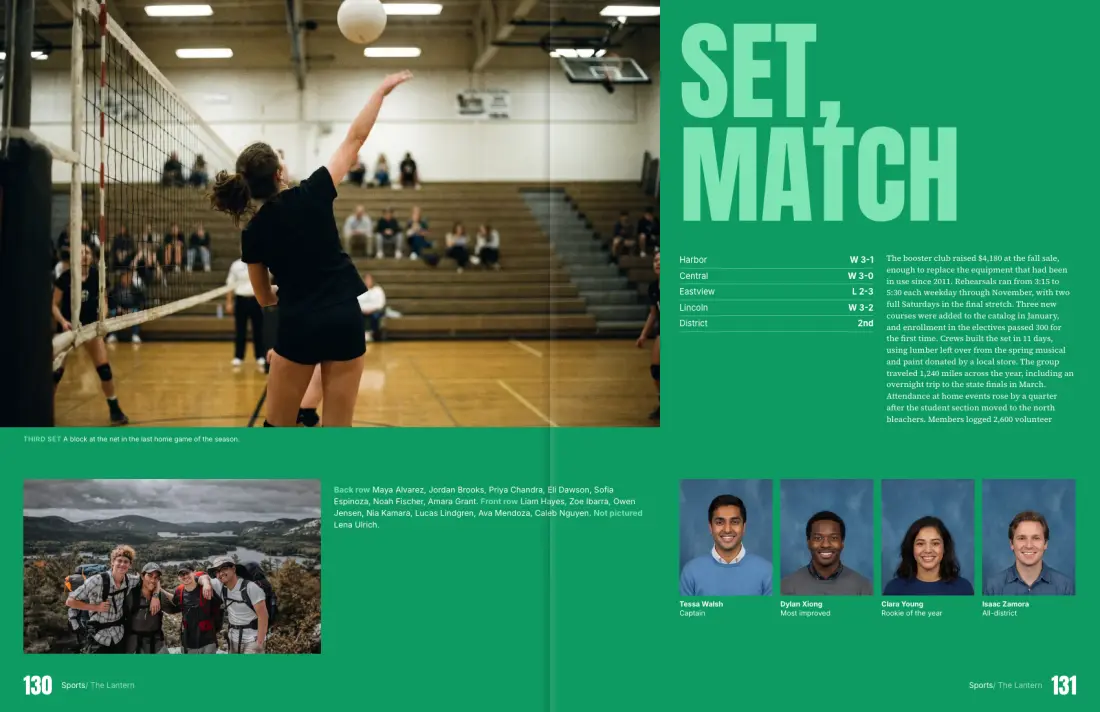
A sports spread carries one dominant action photo, the team photo with names by row, a scoreboard of every result, the season record, a roster, a stats mod and a few lines for the coach.
A paid plan is required to create a yearbook. Printing is a separate order.
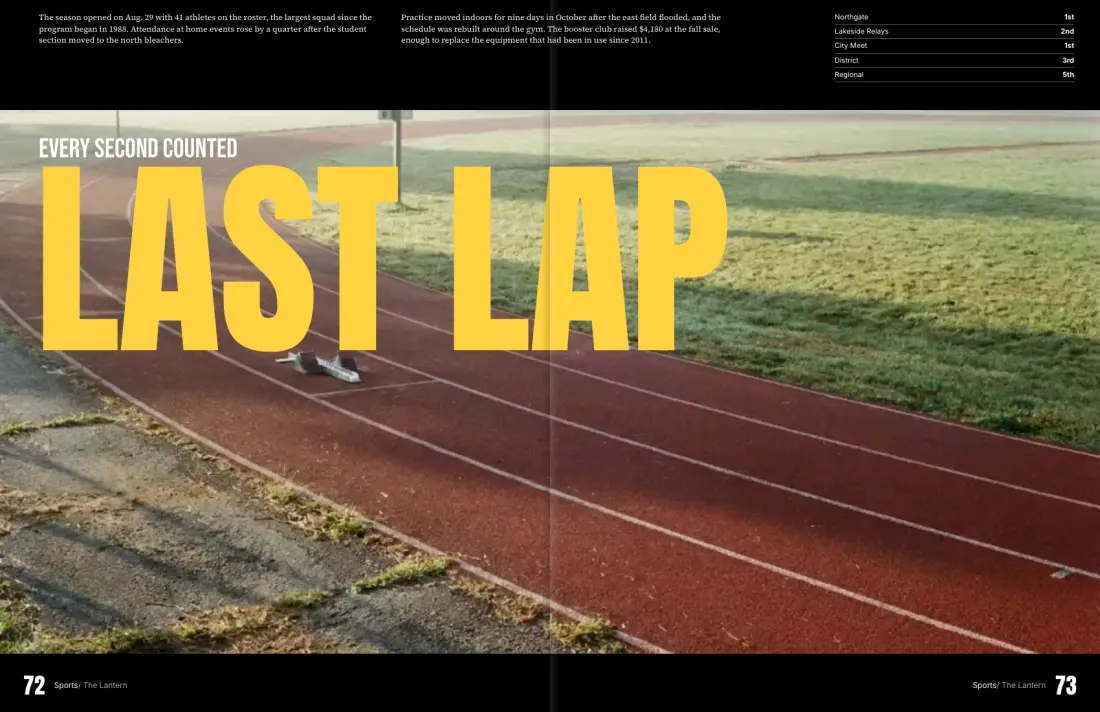
A sports spread does two jobs. The photos show how the season looked, and the reference block records what happened: who was on the team and the score of every fixture.
The same structure works for football, volleyball, basketball and soccer spreads. What changes from sport to sport is where the photographer stands and which numbers go in the stats mod.
See also: Six interview questions for players and coaches, Count the sports pages on the ladder, Spread layout: margins, gutter and eyeline.
Start a yearbook
Choose a style, a page count and space for each student. Build the sports section online.
A paid plan is required to create a yearbook. Printing is a separate order. Plans and prices.
| Element | What it shows | Size on the spread |
|---|---|---|
| Dominant action photo | One player in mid-play with the face and the ball visible | A quarter to a third of the spread; may cross the gutter if no face sits in the fold |
| Supporting action photos | Other players, the bench, the warm-up and the crowd | 4 to 6 photos, each under half the area of the dominant |
| Team photo | The whole squad in rows, with coaches and managers | A strip the full width of one page, 50 to 70 mm (2 to 2.75 inches) tall |
| Names by row | Front row first, left to right, then each row behind | Caption type directly under the team photo |
| Roster | Name, shirt number, position and year group for every player | A narrow column, or merged into the names by row |
| Scoreboard | Every fixture in date order: opponent, home or away, score | One narrow column, about a sixth of a page |
| Season record | Wins, losses and draws, plus the league or tournament finish | One line at the head of the scoreboard |
| Stats mod | 3 to 5 season numbers from the scorebook, such as points, goals or fastest times | A quarter page or less |
| Coach space | Coaches' names, years with the team and a quote from an interview | 4 to 6 lines beside the team photo |
| Captions | Who is pictured, what is happening, the opponent and the date | 2 or 3 lines touching each photo |
| Headline and folio | The sport, the level and the season; page number and section label | Headline by the dominant photo; folio in the outer bottom corner |
Download this table as a spreadsheet (CSV)
What every sports spread carries
Plan 6 to 8 photos for the spread: one dominant action shot, 4 to 6 smaller ones and the team photo. The table below lists all 11 elements with the room each one takes.
The reference block is what people look up years later, so it is the last thing to cut. If space runs short, lose a supporting photo before a result or a player's name.
Caption every action photo with who is in it, what is happening, the opponent and the date. A sports caption without the opponent cannot be matched to the scoreboard.
One spread per team, shared spreads and equal space
List every team at every level first: varsity, junior varsity and first-year (freshman), girls' and boys'. Basketball alone can mean six teams, and each of them needs a place.
A common split gives each varsity team a spread. Its junior varsity and first-year teams share the next, each with a team photo, names by row and a scoreboard. Golf and tennis can share too.
Give girls' and boys' teams in one sport the same pages, the same number of photos and a dominant photo of the same size. Check those counts on the ladder, not by eye.
Scoreboards, records and rosters
Take results from the athletic director's records or the coach's scorebook, never from memory. List every fixture in date order with the opponent, home or away, and the score.
Ask the coach to initial a printout of the roster and the scoreboard. Shirt numbers change during a season, and a player who left in October may still be on the first list.
Spring seasons often finish after the final deadline. Print the record up to a stated date and say so on the page, or cover last spring's complete season in this year's book.
Action photos by type of sport
An action photo needs a face and the ball, baton or water in one frame. Stand where play comes towards you, because a picture of a player's back identifies nobody.
Use a shutter speed of 1/500 of a second or faster in a gym and 1/1000 outdoors, with no flash. Photograph the bench, the huddle and the handshake line as well as the play.
- Field (football, soccer): stand behind the end line or goal line, to one side, so attacks run at you. A 200 mm lens or longer reaches midfield.
- Court (basketball, volleyball): sit on the baseline beside the basket, or behind the end line facing the net, low enough to see faces under raised arms.
- Pool: photograph butterfly and breaststroke head-on from the end of the lane as the swimmer breathes, and freestyle from the side the swimmer breathes on.
- Track: stand beyond the finish line for sprints and outside the final bend for distance races. For jumps and throws, catch the release or the highest point.
Lay out the spread
Place the dominant photo first, with the action moving towards the gutter so the eye stays on the spread. Keep faces and the ball at least 13 mm (half an inch) from the fold.
Put the scoreboard in the outside column of the right-hand page, in the same position on every sports spread. A reader flicking the page edges then finds any team's results.
In tbf scrapbook a sports spread is two of the yearbook's shared pages. You place the photos and type the scoreboard and roster yourself; nothing imports results or matches names.
Pages to make
List teams and levels
Count every team, girls' and boys', at every level, then give each a spread or a share of one.
Book the photographer
Send somebody to the same number of fixtures for each team, with a position chosen for that sport.
Collect the reference block
Get the roster, the results and the season record from the coach in writing.
Lay out and check
Place the dominant photo, then have the coach initial the names and scores on a proof.
Questions
What goes on a sports spread in a yearbook?
A dominant action photo, 4 to 6 supporting photos, the team photo with names by row, a roster, a scoreboard of every fixture, the season record, a stats mod and space for the coach.
How do junior varsity and first-year teams fit in?
They usually share a spread that follows the varsity team's. Each still gets its own team photo, names by row and scoreboard, even when there is no room for action photos.
Can I make sports spreads in tbf scrapbook?
Yes, on a paid plan, using the yearbook's 12 to 100 shared pages. You place the photos and type rosters and scores yourself. Nothing is imported, and printing is a separate order.
Sources
Before you finish
Plan the yearbook pages
Choose the number of students, their space and the shared pages in Studio. The total includes both covers and must be even, up to 300 pages.
A family book can use shared pages without individual student pages. Print limits depend on the binding you choose.