
Student life yearbook pages: 24 ideas by term
Student life covers ordinary school days outside lessons, clubs and teams. Plan 8 subjects a term, 24 in all, such as the commute, lunch and lockers. Most fill a mod and a few fill a spread.
A paid plan is required to create a yearbook. Printing is a separate order.
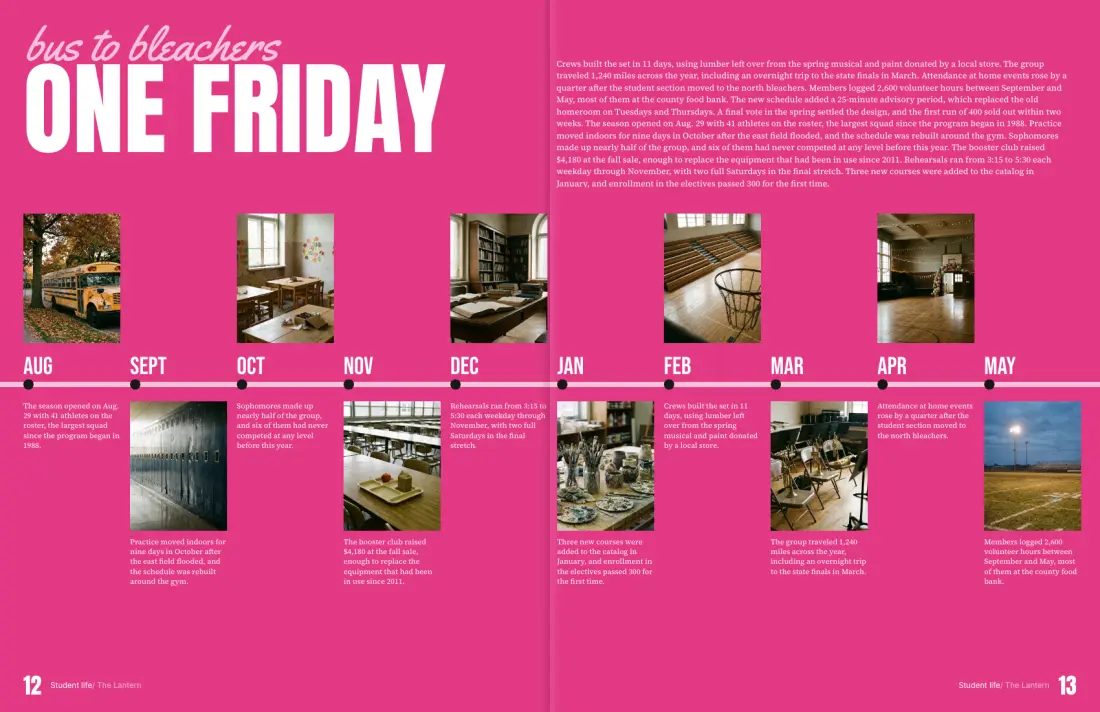
Student life is the section about the parts of a school day no timetable lists: how people arrive, where they eat, what they wear and what they do after the last bell.
The 24 subjects below are split by term, 8 each for autumn, winter and spring. Each one is something to photograph and count. None of them is wording for your page.
Dances, spirit week and homecoming are events and usually get spreads of their own. These subjects are for the ordinary weeks between them.
See also: Give the section its page range on the ladder, Questions to ask the people you photograph, Photo ideas for the same spreads.
Start a yearbook
Choose a style, a page count and space for each student. Start the yearbook online.
A paid plan is required to create a yearbook. Printing is a separate order. Plans and prices.
24 student life subjects, 8 a term
Autumn term (fall): 8 subjects
- The commute: bus, car, bike and walking counts, with the time each group reaches the gate
- First-week lockers: what is taped inside the door, counted by type
- Lunch: where each year group sits and the five items bought most often
- Shoes: one photo of feet per homeroom or tutor group, sorted by style and counted
- Part-time jobs: who works where, hours a week and the latest finish
- Study spots: the library, the stairs, the corridor floor and a kitchen table
- Friday nights: what pupils do in a week with no fixture to watch
- Phones: lock screens, battery level at 3 pm and screen-time totals
Winter term: 8 subjects
- Weather days: snow, ice or a closure, photographed in the grounds and at home
- Coats and layers: what the corridor wears in the coldest week of the year
- Playlists: the most-played song in each year group, set out as a chart
- Dark mornings: the first bus, the first classroom light and the caretaker's round
- Revision and exam weeks: flash cards, timetables and desk set-ups
- Indoor lunch: card games, chess boards and the queue for the microwave
- Pets: who is waiting at home, with species counted across one year group
- The hour after the bell: where pupils go between 3 and 6 pm, drawn as a clock
Spring term: 8 subjects
- Weekends: one pupil from each year group followed for a Saturday morning
- Fashion: the same corridor photographed in autumn and again in spring
- Outdoor lunch: the field, the benches and the first warm day
- Driving and cycling: first licences, first cars, bikes and who gives whom a lift
- Hobbies nobody sees at school: instruments, gaming, baking and fishing, one photo each
- Siblings in the building: pairs and trios photographed together, with the age gap
- The last-week locker clear-out: what goes home and what goes in the bin
- Summer plans: jobs, trips and courses, counted from a one-question form
| Kind of subject | Space | Photos | Fact to collect |
|---|---|---|---|
| Routine with movement: commute, lunch | Full spread | 5 to 7 | Counts by transport or by table |
| Objects: lockers, shoes, phones | Half-page mod | 6 to 9 close-ups | A count by type |
| Counts only: playlists, summer plans | Quarter-page mod | 0 or 1 | A ranked list and the number of replies |
| Out of school: jobs, pets, weekends | Half page or a mod | 3 to 5 sent in | Place, hours or species |
| Unplanned: weather days | Full spread or a strip | 4 to 8 | The date and what closed |
| Comparison: fashion, lockers twice | Half page | 2 matched shots | The two dates |
Download this table as a spreadsheet (CSV)
What student life coverage is
The section records habits, not events: a walk to school at 7.40, a queue at the canteen hatch, a row of lockers. Anybody in the building can appear in it without joining anything.
That makes it the fairest section in the book. Sports and clubs cover the people who signed up, while student life can reach the pupil who goes home at the bell.
Treat each idea as a subject with three parts: a photo, a number and a name. A locker row with a sticker count and one named owner is coverage. A locker alone is decoration.

How many spreads it usually gets
A traditional page plan gives student life about a fifth to a quarter of the book. In a 200-page book that is 40 to 50 pages, which is 20 to 25 spreads.
Small books cannot spare that. With 24 shared pages, give student life 3 spreads, one a term, and run the other subjects as mods on spreads that belong to other sections.
A tbf scrapbook yearbook has 12 to 100 shared pages, so a fifth to a quarter is roughly 2 to 25 of them. Fix the share on the ladder before anybody is sent out with a camera.
Spread or mod: how much room a subject needs
A full spread needs one dominant photo, 4 to 6 smaller ones, a caption for each and one mod of counts. Choose subjects with movement for spreads: the commute, lunch, a snow day.
A mod is a boxed sidebar, usually a quarter page or less. It needs 3 to 5 small photos or one chart, each with a name and a year group. Phones, playlists and pets suit mods.
Eight subjects a term works out as 1 or 2 spreads and 6 or 7 mods. Collect the counts with a one-question form and print how many people answered beside the result.
Cover people who are in no club or team
Print the full roll and tick a name each time that person is pictured or quoted. Once portraits, clubs and teams are ticked, the names with one tick are your student life list.
Send photographers to places, not to people they know. The bus bay, the bike rack, the library at lunch and the car park at 3.15 hold pupils no club photo will ever include.
A common staff target is every pupil in the book three times, portrait included. Check the roll at the end of each term and aim the next term's mods at whoever is still short.
Collect by term, not in May
Autumn cannot be photographed in spring. Assign each term's 8 subjects in its first week, with an owner, a date and a format, and finish them before the next term starts.
Weather days need a standing plan, because nobody schedules snow or a heatwave. Name two people who photograph the grounds that day and one who gathers pictures taken at home.
Jobs, pets and weekends happen where no staff photographer goes. In tbf scrapbook you can invite other people to add photos to the book, and you choose which ones reach a page.
Pages to make
Fix the page share
Give student life a fifth to a quarter of the shared pages, or one spread a term in a small book.
Assign 8 subjects a term
Each subject gets an owner, a date and a format: spread or mod.
Collect photo, number and name
Every subject needs all three before it is laid out.
Tick the roll
Mark every pupil who appears and point next term's subjects at the names still short.
Questions
What counts as student life in a yearbook?
Anything about the school day and the hours round it that is not a lesson, a club or a team: travel, lunch, lockers, clothes, jobs, weekends and weather.
How many pages should student life get?
A traditional plan gives it a fifth to a quarter of the book. A small book can run 3 spreads, one a term, and place the remaining subjects as mods in other sections.
Can I make student life pages in tbf scrapbook?
Yes, on a paid plan. A tbf yearbook has 12 to 100 shared pages for sections like this one. You place the photos and write the captions yourself, and printing is a separate order.
Sources
Before you finish
Plan the yearbook pages
Choose the number of students, their space and the shared pages in Studio. The total includes both covers and must be even, up to 300 pages.
A family book can use shared pages without individual student pages. Print limits depend on the binding you choose.