
Yearbook club pages: fit 20 clubs on 4 spreads
Put 5 clubs on each spread. One is featured with a dominant photo across half the spread, and the other four each get a quarter-page block: group photo, names by row and three facts.
A paid plan is required to create a yearbook. Printing is a separate order.
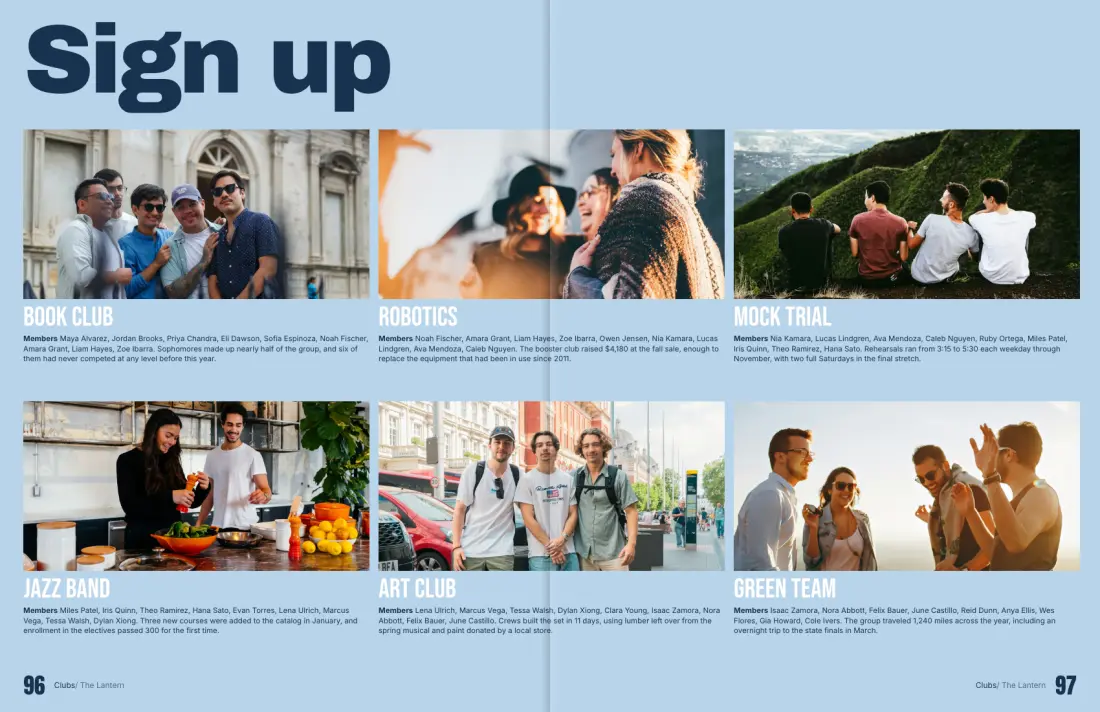
Club pages go wrong in two ways. Three large clubs take a spread each and the others get a line, or 20 group photos are stacked in a grid with nothing to read.
The plan here puts 20 clubs on 4 spreads, 5 to a spread. One club per spread is featured with a dominant photo, and the other four get identical blocks of photo and facts.
See also: Mods: the boxed blocks this plan is built from, Six interview questions for club members, The same reference block, for teams.
Start a yearbook
Choose a style, a page count and space for each student. Lay out the club pages online.
A paid plan is required to create a yearbook. Printing is a separate order. Plans and prices.
| Spread | Grouping | Featured club, 4 modules | Standard blocks, 1 module each |
|---|---|---|---|
| 1 | Service and leadership | Student council | Service club, peer tutors, environment club, school newspaper |
| 2 | Arts and performance | Drama club | Choir, art club, dance club, film club |
| 3 | Academic teams | Robotics | Debate, maths team, science club, quiz team |
| 4 | Interests and culture | International club | Chess club, book club, gaming club, language club |
| Total | 4 groupings | 4 featured clubs on 16 modules | 16 clubs on 16 modules |
Download this table as a spreadsheet (CSV)
The worked example: 20 clubs on 4 spreads
Divide each spread into 8 equal modules, 4 to a page. The featured club takes 4 modules, the area of one page, and may cross the gutter. Each of the other four clubs takes 1 module.
On A4 with 12 mm margins and 6 mm between blocks, a module is 90 by 133 mm. On US Letter with half-inch margins and a quarter-inch gap it is about 3.6 by 4.9 inches.
Group the clubs by kind so each spread has a subject: service, arts, academic teams, interests. Feature the club with the strongest action photo this year, not the largest one.
What each club block carries
Every standard block holds the same five things in the same order, so a reader can compare clubs and find a name quickly. The featured club adds 3 or 4 action photos to those five.
Write what the club did as facts, each with a number, a date or a place. Three facts fit one module. An adjective about the club's spirit tells a reader nothing in ten years.
- Group photo, 90 by 60 mm (3.5 by 2.4 inches), with everyone facing the camera
- Names by row, front row first, left to right
- Three facts about this year: what was made, raised, won, visited or performed
- Meeting day, time and room
- The adviser's name, and the officers' names with their roles
Collect it with one form and one photo day
Send every club adviser the same form in the first month, due back in two weeks. It asks for the club's name as printed, adviser, meeting day and room, officers, member count and three facts.
Add one question about dates: which event this year should a photographer attend. The answers decide which clubs can be featured, since a feature needs action photos.
Take all the group photos on one day in one place, 10 minutes a club. Twenty clubs take 3 hours 20 minutes. A helper writes each row's names on a sheet before anybody moves.
Keep it fair between large and small clubs
Block size follows the plan, not the membership. A club of 6 and a club of 60 each get one module. The small club's photo is cropped tighter and the large club's names run in two columns.
If a group is too big for faces to be told apart at 90 mm wide, split it into two photos by year group inside the same block. A second module is not given to one club and refused to another.
Keep a record of which clubs were featured and hand it to next year's staff. Four features a year means each of 20 clubs can lead a spread once in five years.
Alternatives: a club directory and an events calendar
With more than 20 clubs, or fewer than 8 pages to spare, run a club directory: one page with a row per club giving its name, meeting day, room, adviser and member count.
A calendar of club events is the second option: one spread, month by month, with a line and a small photo for each event. It suits clubs that do things but seldom pose.
In tbf scrapbook the 4 spreads are 8 of the yearbook's 12 to 100 shared pages. You can invite advisers to add their club's photos, then build each block yourself from photos and typed text.
Pages to make
List and group the clubs
Sort all 20 into 4 groups of 5 by kind, one group to a spread.
Send the form
One form per adviser, due in two weeks, asking for names, meeting details and three facts.
Hold the photo day
Ten minutes a club in one place, with a row sheet filled in at the shoot.
Choose the features and lay out
Feature one club per spread on 4 modules and give each of the others 1 module.
Questions
How many clubs fit on one yearbook spread?
Five, if one is featured on half the spread and four take a quarter page each. Eight fit if every club gets an equal quarter-page block and none is featured.
What should a club's yearbook block include?
A group photo, names by row, three facts about what the club did this year, the meeting day and room, and the adviser's name. Officers' names go beside the adviser's.
Can I make club pages in tbf scrapbook?
Yes, on a paid plan. Four club spreads use 8 of a tbf yearbook's 12 to 100 shared pages. You build the blocks by hand from photos and typed text; there is no club form or name import.
Sources
Before you finish
Plan the yearbook pages
Choose the number of students, their space and the shared pages in Studio. The total includes both covers and must be even, up to 300 pages.
A family book can use shared pages without individual student pages. Print limits depend on the binding you choose.